Writing Down The Early Psalms

As I dug around, I found this: it’s the order of the early Psalms. Basically, a chronological way of seeing when, and why he wrote a “song.” I found it quite interesting to see the backdrop or setting of each one. 

Please remember two words when you read the Psalms: 

  • Authentic observations 
  • Profound theology 

It’s a collection of songs, not in any real order. Interestingly David only wrote about ½ of them. Also, they are lyrics, we don’t have notes or melodies. Which is somewhat sad. I guess we’ll hear them when we go to heaven. 

The psalms cover over the span of 1000 years. Psalm 90 was written as the earliest; Moses was the author in 1407 BC. The latest was written anonymously in the mid-400s BC. Thus, the book of Psalms was written over the span of about 1,000 years. 

New Testament leaders, including Jesus quotes the Psalms frequently. Some of these were directly connected. For example, the work of Jesus is directly revealed in Psalm 22. Many others are linked to specific verses. It’s all is pretty fascinating. 

Here’s some interesting trivia: 

  1. Psalm 119 is the longest chapter in the Bible, containing 176 verses. 
  1. Psalm 117 is the shortest chapter, containing only two verses. So, the Psalms contain both the longest and shortest chapters in the Bible. 
  1. Psalm 117 is also the middle chapter of the whole Bible out of a total of 1,189 chapters. 
  1. Psalm 118:8 is the absolute center of the Bible. It states, “It is better to trust in the LORD than to put confidence in man.” What a great verse for our day and age.1 
  1. Did you know that there are duplicate Psalms? A lot of people don’t realize that. Psalms 14 and 53 are word-for-word identical descriptions of fallen mankind. And there is a reason why those duplications are needed in each of the books one and two. They are structurally important for understanding those books. Likewise, all of Psalm 108 is included as part of Psalm 60, and all of Psalm 70 is included as part of Psalm 40. 

When and where: 
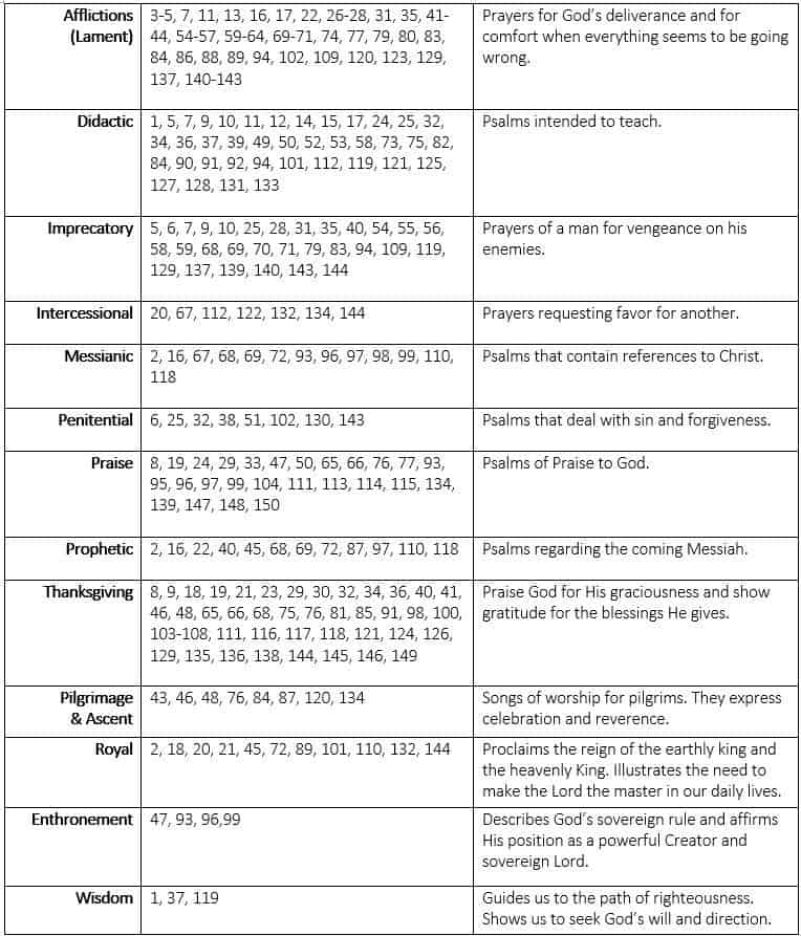
The entire list can be found at https://biblehub.com/timeline/psalms/34.htm 

Also, https://dailypax.com/p-is-for-psalms/ 

See also, https://biblicalblueprints.com/Sermons/BibleSurvey/16%20psalms 

Learning to Sing

Sometimes we desperately need to sing. And perhaps we should write down a simple, faltering poem. I would suggest that you not make it public, unless told otherwise. This is just between you and your heavenly Father.

I’m told that David wrote 73 psalms.

These psalms are contextual (that is his experiences). They can be prophetic. They also declare a devotional meaning. Whatever. But one overriding truth is very present: the Holy Spirit infuses David’s words. What he writes is inspired and guided by God Himself.

That is remarkable.

This is David’s best Psalm. I strongly suspect that it was heavily influenced by the sheep, the pasture, and even the predators. I also think loneliness and isolation enabled him to write and sing with such power, and beauty.

Psalm 23 has brought comfort to millions. The sick and dying, the captive and prisoner, believer and non-believer have found profound consolation from David’s simple words.

23 The Lord is my shepherd;
I shall not want.
He makes me to lie down in green pastures;
He leads me beside the still waters.
He restores my soul;
He leads me in the paths of righteousness
For His name’s sake.

Yea, though I walk through the valley of the shadow of death,
I will fear no evil;
For You are with me;
Your rod and Your staff, they comfort me.

You prepare a table before me in the presence of my enemies;
You anoint my head with oil;
My cup runs over.
Surely goodness and mercy shall follow me
All the days of my life;
And I will dwell in the house of the Lord
Forever.

A Grinding Humility

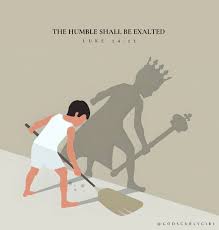
Luke 14:11

David was the eighth and youngest son of Jesse. They lived in Bethlehem and David served his father by tending his sheep. Like Moses, David learned the skills from life as a shepherd. He wasn’t valued by his family. He lived out in the field and simply did whatever he was told.

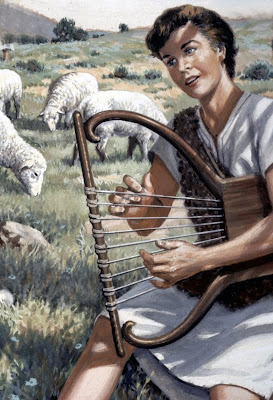
A diversion for young David was to sit and play a lyre. It calmed the sheep, and gave himself something to break the blind-numbing boredom of watching over a flock. He also learned the sling, punching rocks at targets both near and far. He got really good at both.

These things will determine David’s role as a king, and a shepherd of the nation of Israel.

But these are humble acts which seem small at best. And yet, given time, they will grow and will become the very basic foundations of a good king. Being a shepherd and protecting the flock is exactly what God wants. He seeks out those who have His heart.

Just perhaps this is what it really means to be a pastor, an elder, or a deacon. May we look to those who love the flock, and who can throw a stone or two.

John Stott