Being Betrayed

1 Samuel 23:7-12, NLT

This passage reveals three details that are especially important to the reader.

  • Saul still believes that he has God’s approval and blessing.
  • David is still seeking the Father’s will and wisdom
  • Keilah, freed from attack by the Philistines by David, will turn right around and betray David.

Saul still believes.

It’s odd how someone like King Saul can still believe that the Lord is guiding him. His heart is honeycombed with jealousy and murder, and yet he doesn’t see it. He still thinks that wearing a crown gives him the automatic privileges of divine kingship and blessing.

What self-deception, Saul has not had God’s approval for a very long time, (see 1 Samuel 15:10-30). Obedience is far better than any sacrifice. Saul has been living outside of the presence for a long time.

“As the salt flavors every drop in the Atlantic, so does sin affect every atom of our nature. It is so sad there, so abundantly there, that if you cannot detect it, you are deceived.”

Charles Spurgeon

David is still seeking.

Hearing the desperation of Keilah, and then seeking the Lord of what to do, he directs his men to protect the city. He makes no strategic decision that could possibly put him outside of God’s will. He will not do this.

“The greatest mistake any Christian can make is to substitute his own will for the will of God.”

Harry Ironside

Keilah, will betray David.

This is so treacherous, it can hardly be believed or understood. The hearts of lost men only seek their own benefit. The elders of Keilah turn around and sell out those who had just delivered them. David seeks again God’s will and finds out that they will be betrayed. What should have been a celebration of joy only discloses lies and falsehoods.

Ironic, isn’t it. David and his 400 men escape the town they had just saved.

Psalm 17:9

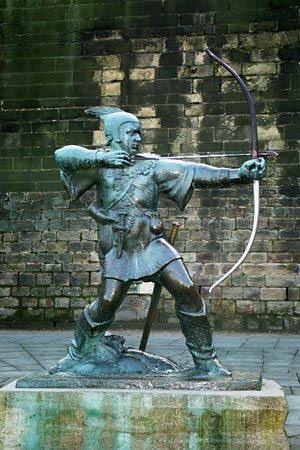
David Hood & His Merry Men

David can’t shake off the desperation of the Keilahites. Their plight becomes a passionate purpose for David. He hears of the need, and understands the injustice of these Philistine raiders. He knows deep down that they must be stopped.

Spiritual “wealth” is found here in this passage. Gold nuggets, and flawless diamonds for the taking. Let’s get started. 

But here’s a few things that might be helpful. 

  • It seems that David is quite approachable. He listens to the guidance of his men. He listens and then responds. David never diminishes their concerns, they’re depending upon him.
  • David seeks the guidance and will of the Lord twice because of their caution. 
  • David is going to do what King Saúl was supposed to do; to protect and defend the city of Keilah. It seems Saul had abdicated his call as king in his desperate pursuit of David. 
  • There seems to be a real risk involved. This was not a summer stroll. 
  • David knows in his heart what he has to do. Since Saul didn’t come to defend Keilah, he must do what is needed. 
  • God does not chide David for asking twice. There seems that there were several men in the Old Testament that required another ‘conversation’ with God. 

Can we do what is right when the situation demands it? Sometimes we see a need that others have neglected to meet. Can we step into what is needed at that moment?

What if the “detours” and the interruptions are really the path we were meant to take?  

These are good questions to ask ourselves.  Our compassion should not be rigid. I remember a time when the Lord asked me to be interruptible. That is, to set aside what I thought was essential, to take up something that made little sense, but did matter to the one asking. 

When I learned to be interrupted, it ended up giving me a blessing that came out of nowhere. Hitting the pause button is rarely a mistake if you believe the Holy Spirit is leading you. 

War Crime: Aftermath

1 Samuel 22:20-23 

The terrible slaughter of the town of Nob had been total—well, almost. One man escaped and ran to David.  His name is Abiathar. He brought the report to David of the complete massacre of everyone. Abiathar also identified Doeg the Edomite as the murderer. 

David has a soul searching, reflective response to this news.  

This intrigues me. “I knew…” and “I caused…” David now realized his actions had terrible consequences. He voices his complicity out loud. In his heart he sees his guilt (at least partially). This dark murder would change him. 

His sin was lying to the high priest.  

David deceived him. Doeg also saw David manipulating Ahimelech and Doeg remembered this. In a sense David in his awful duplicity created death for the priestly city of Nob. In his heart, he understood what he had done. 

We must realize how our evil has ramifications.  

It’s like throwing a rock in a still pool. Concentric waves happen as a result, and they cannot be stopped. Consequences to sin affect others and often we never realize it. But here we see David seeing it and responding like he did. 

David seems to have a tender heart to respond to what he has done. It becomes the impetus of Psalm 52 which was written during this time. Here we can read what he was thinking. Here’s the title and verses 1-3. 

Psalm 52:1-3

It’s quite apparent that David survives his guilt, and that is a powerful lesson for us. There are things that must be turned over to God. There is forgiveness for the evil we have done. We must give that to God. 

Psalm 103:12

War Crime

Why have you encouraged him to kill me, as he is trying to do this very day?” 

14 “But sir,” Ahimelech replied, “is anyone among all your servants as faithful as David, your son-in-law? Why he is the captain of your bodyguard and a highly honored member of your household! 15 This was certainly not the first time I had consulted God for him! May the king not accuse me and my family in this matter, for I knew nothing at all of any plot against you.” 

16 “You will surely die, Ahimelech, along with your entire family!” the king shouted. 17 And he ordered his bodyguards, “Kill these priests of the Lord, for they are allies and conspirators with David! They knew he was running away from me, but they didn’t tell me!” But Saul’s men refused to kill the Lord’s priests. 

18 Then the king said to Doeg, “You do it.” So, Doeg the Edomite turned on them and killed them that day, eighty-five priests in all, still wearing their priestly garments. 19 Then he went to Nob, the town of the priests, and killed the priests’ families—men and women, children and babies—and all the cattle, donkeys, sheep, and goats. 

20 Only Abiathar, one of the sons of Ahimelech, escaped and fled to David. 21 When he told David that Saul had killed the priests of the Lord, 22 David exclaimed, “I knew it! When I saw Doeg the Edomite there that day, I knew he was sure to tell Saul. Now I have caused the death of all your father’s family. 23 Stay here with me, and don’t be afraid. I will protect you with my own life, for the same person wants to kill us both.” 

1 Samuel 22:12-23, NLT 

The deeply paranoid king is desperate; he must capture David. Saul needs information and intelligence; at times like this he must rely on his network of spies. Most leaders depend on that. Especially bad ones. 

King Saul is trying hard to find David.

Saul’s consumed. He’s insane. When at last he gets a lead, he takes his army to the priestly city of Nob. Doeg the Edomite gives Saul the tip, he had seen David there, consulting with the Lord, and taking bread and a sword from Abimelech, the high priest. 

Simply based on Doeg’s singular witness, Saul will order the deaths of 85 priests and the entire town of Nob, a city populated with the Levitical priesthood and their families. When Saul orders the murder, his own men refused to carry it out. They simply refused, and so he must rely on the Edomite, Doeg. 

This passage is terrible and reveals all of Saul’s depraved brutality. 

One by one, systematically Doeg murders each priest. The bodies keep stacking up. It’s a massacre. Doeg now begins to slaughter their families. And then to all the livestock, until the entire town is one bloody graveyard. 

I admit I don’t understand exactly why? 

But there is one priest who escapes. Just one man and he flees to David and carries the horrific news of the wholesale slaughter of Nob. Saul and Doeg have completely decimated the city to punish them for aiding David. 

And David remembers seeing Doeg there. He also has a moment of truth as he understands his own guilt in this massacre. I suspect he now understands Saul’s cruelty, and David learns a lesson he will never ever forget. 

EnduringWord.com

“Until I know what God is going to do for me.”

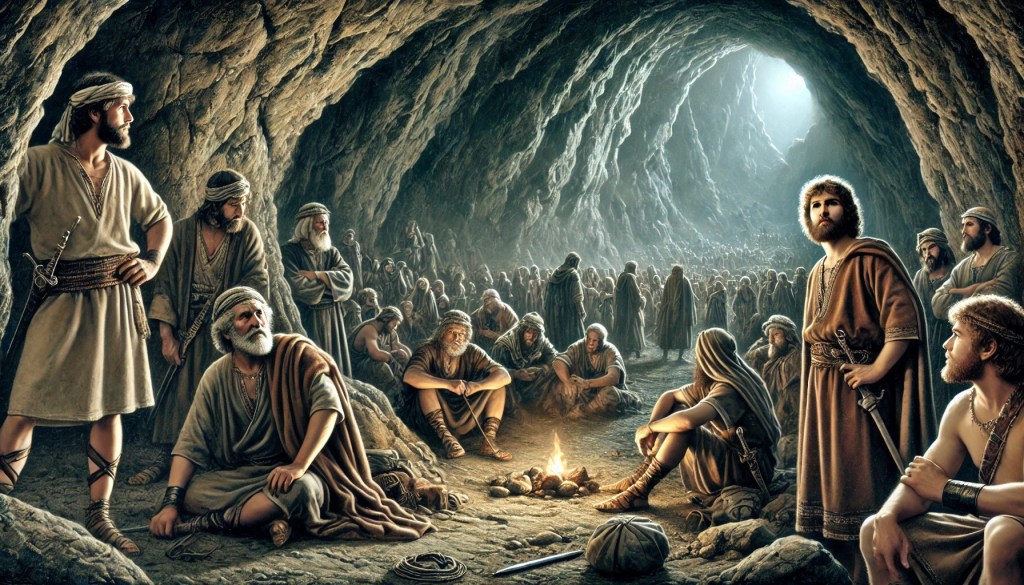
David and 400 (“the 3D men”) are together in the Cave of Abdullam waiting for what, I do not know. I suspect they didn’t know either. For any of us who are in a “holding .pattern,” David’s stay can be understood. But God hasn’t forsaken you, not a bit. Waiting on God is never easy. Every disciple goes through this. 

David takes up this time to care for his parents. You see they followed David out into the wilderness. I’m pretty sure that were prime candidates for blackmailing David. They could be easily taken as hostages by Saul, to manipulate David who is hiding. 

Now there is a reason that they went to Moab. David’s great-grandmother Ruth was a Moabite (Ruth 4:18-22, 1:4). That would mean that one of his parents could claim that Ruth was a grandma to one of them. It’s said that “blood is thicker than water.” That proverb has a powerful theological meaning. 

In his heart he’s taking it one step at a time, and he really doesn’t know what the next step is going to be. He’s walking by faith, not by sight. And you know that is how God works out His will. We don’t always understand, but we do obey. 

Gad the prophet steps up and speaks the word of God to David. He must return to Judah. That is probably not what David wanted to hear; after all, it’s moving toward danger. King Saul rules Judah, and David must be thinking that he would be moving into peril. 

King Saul hears of this and he’s waiting for David.

The safest place to be is in the center of God’s will. Perhaps it’s here that David pens this verse. David is learning that the Cave of Adullam is not a safe place, he must understand his real safety is in the Rock of God. 

Psalm 91:2


The Cave of Adullam

1 Samuel 22:1-2, NKJV. (Background: Psalm 57 and Psalms 142.) 

The cave of Abdullam is now a national park in Israel. It’s part of a system of caves, but this is the biggest and most well-known. Thousands visit it every year; it’s on the list that tourists want to visit. 

Our passage today tells us that immediately after the “insane” David skedaddled from Gath, he travelled to this cave. I suspect that Saul had spied everywhere, so the king had a general idea where David was. But the cave of Adullam was very close to the Philistine border. 

A state of war between Israel and Philistia existed, and king Saul could not risk any appearance of violating that without causing an incident. Perhaps Saul was somewhat content that David was isolated in a “hole in the ground,” and everyone would simply forget him. 

But the was not the case. 

First, it was family, then others came. I suspect David’s brothers may have realized that they now were on Saul’s “list.” 

The others had other reasons. Most knew of David’s prowess as a warband leader; some may have served with him. They may have known of his anointing by the prophet to be the next king. 

Now these I call the “three Ds.” The distressed, the debtors, the discontented, sought out David. Our text tells us there was 400 men (plus their families). If David thought, he was hidden and alone he was mistaken. 

Logistically, I’m not sure how that works out. Where did their support come from? And again, what was Saul thinking? 

I suspect that some of these would develop and become the “mighty men” of David, and they would become some of his generals that David would rely on when he became king. 

Verse 3 tell us that “he became captain over them.” They submitted to David and meshed themselves into whatever destiny may come.

Psalm 57:1, from a song written by David while in the cave of Adullum.

David Pretends Madness

‘Saul has struck down his thousands, 
    and David his ten thousands’?” 

1 Samuel 21:10-15, ESV 

David is now carrying Goliath’s sword, given to him by Abimelech the high priest. That sword was special, for David used it to cut off the head of the renown Philistine champion. I’m sure that David’s memories flooded back to him as he held it.

David was now carrying that sword into Goliath’s hometown. That was foolish and dangerous. He seems to move from the crisis of Saul to the crisis of seeking refuge with the Philistines. The risk was great, and yet David told himself that he had “no choice.” 

Is David still “a man after God’s own heart?” 

Sometimes as believers, we do very foolish things. God has a path for us, and instead of seeking Him we turn to our own understanding. When I think through this account, I come to the realization that I seldom look to the Lord for His wise direction. 

“When people do not accept divine guidance, they run wild. But whoever obeys the law is joyful.” Proverb 29:18 

On his arrival in Gath, David hears the murmuring of the crowd. Interestingly, they call David “the king of the land.” They recognized this before Saul did. This is the first time David has heard that they have known him. That song comes up, and it seems again (like always) it just creates even more problems.

David thought he could find anonymity or sympathy from the Philistines. 

Our passage tells us that David is now “much afraid.” I think he realizes then he has made a very stupid decision by going to Gath, (carrying Goliath’s sword for all to see). His reputation has proceeded with him, and yet David has another plan.

He feigns insanity. I suspect that this was just a split-second decision, something rash and impulsive. He knew that acting insane was the only way to escape. He attacked the doors, scratching them. He foamed at the mouth with his saliva dripping down his beard. 

One look at David acting crazy we see that king Achish dismissed David and his antics as beneath his deliberation. He sees David as a madman, and apparently the king has had his fill of madmen. Some have said that the very presence of an insane person was an evil omen. And to kill them was forbidden. 

The question I have is this. Was David walking in the Spirit or in the flesh? Was David outside of God’s will while he was in Gath?

The title of Psalm 34 reads: “A psalm of David, regarding the time he pretended to be insane in front of Abimelech, who sent him away.” 

The title of Psalm 56 reads: “A psalm of David, regarding the time the Philistines seized him in Gath.” 

Now these are beautiful psalms, and they describe David’s experience in the very heart of the Philistines’ stronghold. Things are getting strange, but David’s heart is still in God’s hand.

What happened here has given believers hope and guidance for centuries.

David Deceives the High Priest

1 Samuel 21:7-9, ESV 

Mark my words; Doeg the Edomite was an evil man. Evil men do very evil things. He is immortalized forever in the pages of 1 Samuel as terribly wicked. Doeg is not a Hebrew, and he is called a chief shepherd overseeing other shepherds, and he was in the service of King Saul. 

Was he a captive? Was he a traitor? And what about this phrase, “detained before the Lord?” I got curious so I looked up the word, “detained.” The Hebrew word is pretty broad and I didn’t get any real insight. It’s used 46x and has several meanings, but the general sense is “restrained, halted, or stopped.” Why? 

(If you want, you can jump ahead to 1 Sam. 22:19 to understand Doeg’s heart.) 

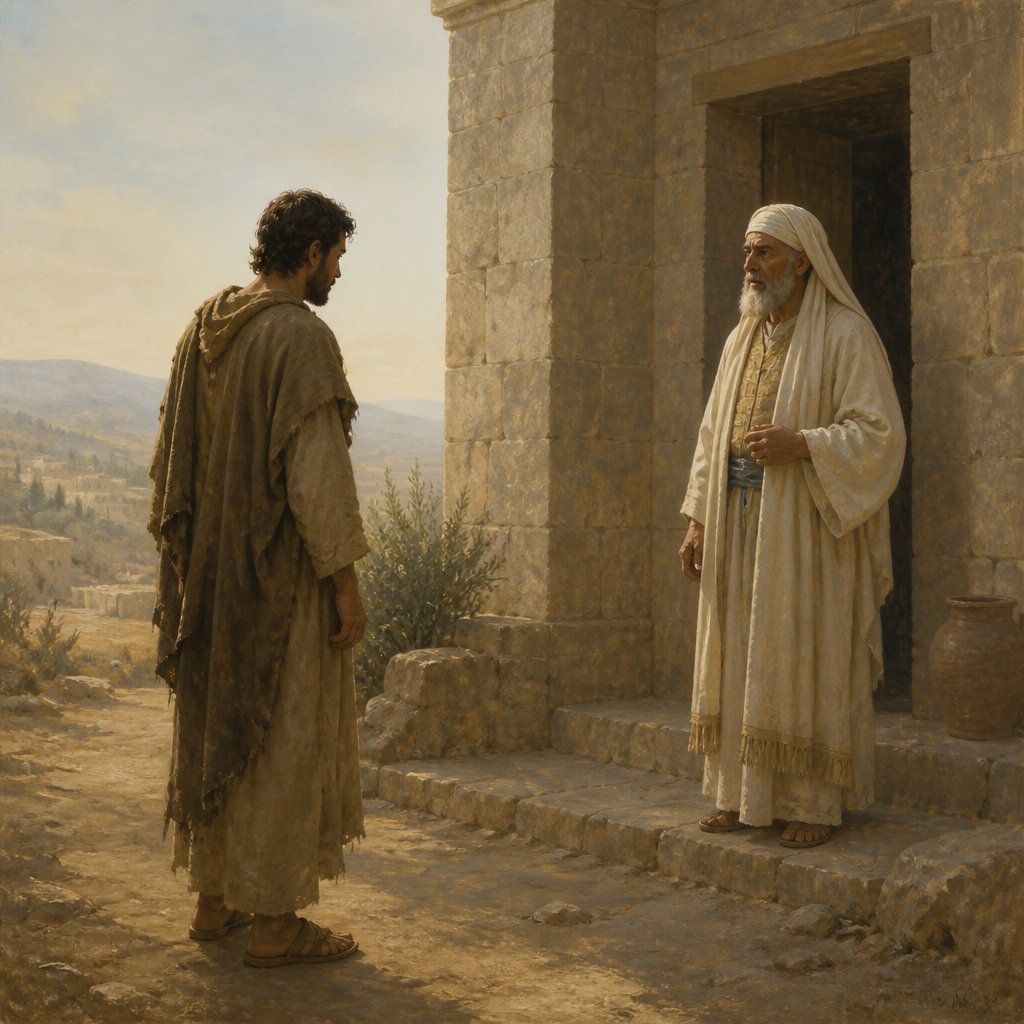
In vv. 7-8 the spotlight is turned back on David and Ahimelech. David continues the charade. His deception lies continue as he presses his need to the high priest of Israel. David takes the holy loaves of bread, but he wants more. He really needs a sword. 

Apparently, the sword that Goliath carried had been kept in Nob in safe keeping. For the priests it was special, maybe even holy. No matter, it was a memento of a glorious victory, but everything is different now. 

“It is painful to the last degree to see one whose faith towered to such a lofty height in the encounter with Goliath, coming down from that noble elevation, to find him resorting for self-protection to the lies and artifices of an impostor.” William Blaikie 

Did you catch that? An imposter. David had become a deceiver, a liar. What do we do with that ugly indictment? I guess I have more questions than answers. Just maybe, in the heat of the moment lying became permissible. 

In Psalm 34 David wrote, “Does anyone want to live a life that is long and prosperous?  Then keep your tongue from speaking evil and your lips from telling lies!” 

Wow, David. Are you sure about that? To be honest, I don’t want to malign with David. After all he was fleeing for his very life. Undoubtably there was a price on his head, and the bounty hunters would be out in force. David was scared out of his wits. 

You might say he was just being resourceful, and he didn’t want to implicate anyone else in his escape. Saul and his army were hunting him, and maybe David thought that the priests would be beyond Saul’s reach. Maybe they would have. 

Except for Doeg, the Edomite. 

Bread From the Table

1 Samuel 21:4-6, ESV 

From reading this passage, we see that David wants to stay one step ahead of Saul. He pretends he’s leading a group of men. This is not true. The reality is that he’s on the run trying to evade the king, and the soldiers. Arriving at the priestly city of Nob he is very hungry. David needs food to continue on. 

For some reason David flees to Nob, a town that has been given to the priests. It also is where the tabernacle was kept during the reign of Saul. That tabernacle was the precursor to the temple. 

I believe that David was drawn to this place because of that. It was a sanctuary. 

I also believe that Ahimelech knew nothing of the conflict between David and Saul. Not that it would change anything, but still David concocted a lie that he was under orders from Saul (v. 3). 

The high priest knew that David had been anointed by the prophet Samuel to be the future king. Perhaps that is why Ahimelech trembled when he first met David (v. 1). “Why has he come here?” 

David was tired, frightened, and hungry. He had made no provision for food, which explains the rapidity of his flight from Saul. David had left as fast as he could. David also knew that the tabernacle at least had bread.

There were 12 loaves (representing the 12 tribes and God’s special covenant with them) of consecrated bread. These loaves were replaced daily. In Leviticus it made it clear that only the priests and their families could eat them.

Each morning, fresh hot bread would be set in the Lord’s presence. Perhaps this signifies God wants fresh fellowship from us every day. Believers will hunger for Him; He will give us “our daily bread.” What He offers us is always fresh, and Jesus knows exactly what we need.

“So the priest gave him holy bread; for there was no bread there but the showbread: In giving David the bread, Ahimelech broke with priestly custom but not with God’s word. He rightly understood that human need was more important than Levitical observance.” 

David Guzik 

But David’s presence would create awful consequences for the priests living in Nob. Terrible things will happen very shortly. 

We will see this in a future post. 

David at Nob

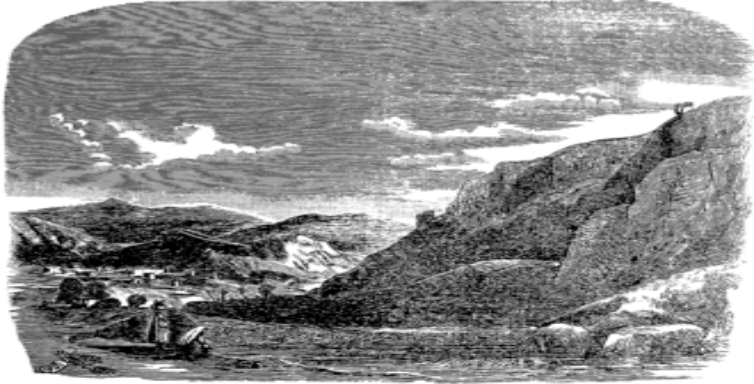
Biblical village of Nob

David was afraid and anxious; he really doesn’t seem to have a plan. So where did he go? He went straight to Nob, the city of priests overseen by Ahimelech the High Priest of Israel. David did right; when you’re confused go to God. 

The Ark of the Covenant was still in Nob. 

We have a fleshly tendency to lean on our understanding. We think we know what is right as we calculate our best move. However, when we lean on our own understanding bad things are apt to happen. Proverbs 3:5-6 fits well here: 

Ahimelech was on edge by David’s arrival. He saw something in David, but he wasn’t exactly sure what it was. I think he also was nervous. The passage points that he “trembled” when he saw David. Why, I’m not sure. 

The word “trembled” has an interesting meaning. Literally it means “terror,” or even an earthquake. Ahimelech was disturbed by David’s arrival, and it seems that he didn’t understand what was happening politically. David had fallen out of favor for some time now. 

David lied to Ahimelech, claiming he was on a secret mission for the king. 

David’s world was complicated; he could trust no one, not even the high priest. These verses advance the idea of paranoia and fear affecting everyone. Ahimelech asked two questions. I believe that he couldn’t really discern David’s reasons for coming to Nob.

It was a bald-faced lie.

David demanded bread. He was hungry and no provision was made before his escape. It would be nice if they had planned better—a secret cache of food and weapons would have been incredibly helpful. 

We will pick this story up in the next post. 

Writing Down The Early Psalms

As I dug around, I found this: it’s the order of the early Psalms. Basically, a chronological way of seeing when, and why he wrote a “song.” I found it quite interesting to see the backdrop or setting of each one. 

Please remember two words when you read the Psalms: 

  • Authentic observations 
  • Profound theology 

It’s a collection of songs, not in any real order. Interestingly David only wrote about ½ of them. Also, they are lyrics, we don’t have notes or melodies. Which is somewhat sad. I guess we’ll hear them when we go to heaven. 

The psalms cover over the span of 1000 years. Psalm 90 was written as the earliest; Moses was the author in 1407 BC. The latest was written anonymously in the mid-400s BC. Thus, the book of Psalms was written over the span of about 1,000 years. 

New Testament leaders, including Jesus quotes the Psalms frequently. Some of these were directly connected. For example, the work of Jesus is directly revealed in Psalm 22. Many others are linked to specific verses. It’s all is pretty fascinating. 

Here’s some interesting trivia: 

  1. Psalm 119 is the longest chapter in the Bible, containing 176 verses. 
  1. Psalm 117 is the shortest chapter, containing only two verses. So, the Psalms contain both the longest and shortest chapters in the Bible. 
  1. Psalm 117 is also the middle chapter of the whole Bible out of a total of 1,189 chapters. 
  1. Psalm 118:8 is the absolute center of the Bible. It states, “It is better to trust in the LORD than to put confidence in man.” What a great verse for our day and age.1 
  1. Did you know that there are duplicate Psalms? A lot of people don’t realize that. Psalms 14 and 53 are word-for-word identical descriptions of fallen mankind. And there is a reason why those duplications are needed in each of the books one and two. They are structurally important for understanding those books. Likewise, all of Psalm 108 is included as part of Psalm 60, and all of Psalm 70 is included as part of Psalm 40. 

When and where: 

The entire list can be found at https://biblehub.com/timeline/psalms/34.htm 

Also, https://dailypax.com/p-is-for-psalms/ 

See also, https://biblicalblueprints.com/Sermons/BibleSurvey/16%20psalms 

Jonathan’s Secret Message

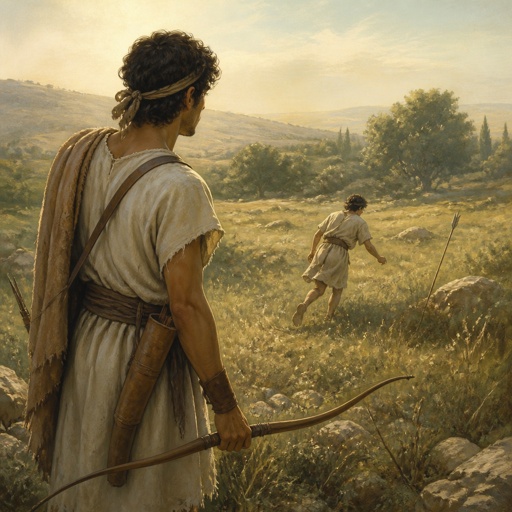
In verses 36-39 a young boy was chasing down arrows. The plan was one both David and Jonathan understood. If the arrows fell short, it meant David could return safely and securely to the court of Saul. But if the arrows went long, David had better run. 

1 Samuel 20:39-42, ESV

As I read these last few chapters, I’m amazed by David’s desire for reconciliation with the king. He desperately wants peace; David wants restoration, but the “ball” is in Saul’s court now. Now, I guess that I wouldn’t be as patient as David. But that only emphasizes the wonderful character of David. 

I also sense that David wanted to avoid the wilderness. He never wanted to go there, maybe the wilderness was a place of “death.” Maybe not a physical one, but a death to everything David knew. It would be a hard place: thirsting, scavenging, and hiding. A difficult place to survive. 

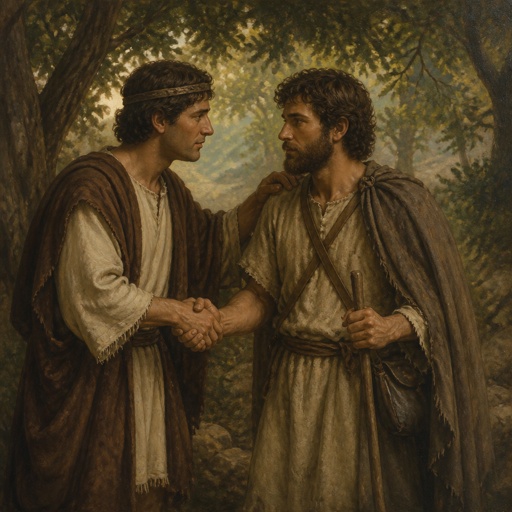
There is one last time that David and Jonathan will meet. I think it was something bittersweet, and each reassured their covenant to each other. There must’ve been much pain. Neither wanted this, of all things to happen. Sometimes we’ll be put in a similar situation. It’s always difficult. 

Jonathan, knowing that David has been anointed the next king of Israel, submits his heart to what the Lord God has decided though the prophet Samuel. He accepts this and refuses to take the route of Saul, rather Jonathan appeals to David as the future king. 

The request is a bit bold maybe, but Jonathan asks that David would honor this, “between my offspring and your offspring, forever.’” Jonathan is asking David to refuse revenge and not try to get even with the house of Saul. Now David could have made an end to Saul’s progeny; that could mean stability for him, and for Israel. 

It’s then that must say goodbye, each goes on their very separate paths. This is the very last time they were together, but I doubt they would never forget their covenant. 

True Colors

Saul wants to kill David

Jonathan now knows; his father’s true colors were now obvious, which almost always happens over time. Saul hates David and now begins an even more effort to murder him. His hatred now consumes him. The king is no longer rational. He wants to kill him. 

But Jonathan is committed to warning David. He loves his friend; and so, he sticks with a prearranged signal. He will risk everything. David must be warned. 

1 Samuel 20:36-38, ESV 

Those arrows were genius—a plan that was wonderful and kept Jonathan safe. And David would now know his next step. I must admit I see no reference to prayer or seeking God, that troubles me. (But I must assume the singer of Psalm 23 understood God’s protection and care.) 

1 Samuel 20:41-42 

David saw the arrows and heard Jonathan speak. I suspect his heart sank. He wanted reconciliation and he didn’t want to leave in this way. And he didn’t want to go out in the wilderness. He was now a fugitive on the run. 

David loved Jonathan and it showed it. There was nothing cold or professional. He expressed a love that went beyond “bad news.” It wasn’t contingent on terrible news, for it was real, authentic. He had made a covenant. 

David will now spend the next 10-15 years on the run from Saul. 

He will try to live in the wilderness. But David would be protected by the Lord, and although he didn’t realize it, he was on a timetable set by God Himself. The clock was running but David was learning many things about being a king. His education would be long and hard. 

“Experience: that most brutal of teachers. But you learn, my God, do you learn.” 

 C.S. Lewis 

I believe David still had his harp, and I believe he would still worship the Lord God. He would compose even more psalms. And much of the wilderness would be woven into what he would sing. Worship was at his very core. 

And worship is why we exist.

The Bow and the Arrows

I will shoot three arrows.” So much depends on these three, will David be restored to the court of king Saul, or will he need to flee into the wilderness?  

Then Jonathan said to David, “Tomorrow is the New Moon; and you will be missed, because your seat will be empty. And when you have stayed three days, go down quickly and come to the place where you hid on the day of the deed; and remain by the stone Ezel. Then I will shoot three arrows to the side, as though I shot at a target; and there I will send a lad, saying, ‘Go, find the arrows.’ If I expressly say to the lad, ‘Look, the arrows are on this side of you; get them and come’—then, as the LORD lives, there is safety for you and no harm. But if I say thus to the young man, ‘Look, the arrows are beyond you’—go your way, for the LORD has sent you away. And as for the matter which you and I have spoken of, indeed the LORD be between you and me forever.”  

1 Samuel 20:18-24 

Jonathan’s plan is simple. It’s a setup after observing the response of Saul to David’s absence at a feast. He is being secretive, his father’s spies are everywhere, but his heart and covenant with David compel him. 

It was the second day, and David’s chair was still empty. Saul noticed this and became furious. It’s this furious anger that betrays him.  

“Then Saul became angry with Jonathan and shouted, “You son of a perverse and rebellious woman! Don’t I know that you are siding with Jesse’s son to your own shame and to the disgrace of your mother? 31 Every day Jesse’s son lives on earth you and your kingship are not secure. Now send for him and bring him to me—he must die!” 

It’s here we see Saul broadcasts his hatred toward David. It exposes everything and now Jonathan knows what is in his father’s heart. It’s a rage that bubbles up for all to see; it is uncontrollable and obvious. David “must die.” 

Pay attention now. Saul attacks Jonathan’s mother in verse 30. We don’t know the details, but it seems that in his anger he disparages the character of Jonathan’s mother. Anger has the tendency to completely twist and distort one’s perception of reality. It’s like a wildfire that can’t be controlled. 

“An angry person stirs up conflict, and a hot-tempered person commits many sins.” 

Proverbs 29:22 

Jonathan’s plan has now become active. He now knows what he must do. He picks up his bow and gets his arrows. He must communicate with David about what he knows. His covenant with David supersedes everything, even the chance to rule as the next king of Israel. 

The wilderness in desperate hiding is the last place David wants to be. As I read the life of David, I see that he doesn’t want this—he has done everything possible to avoid it. This isn’t a choice he makes, rather it’s been thrust on him by God himself. And who can walk with God without doing His will?  

Jonathan shoots his arrows in the field, but wide of the mark. This is David’s cue that he must run; Saul intends to murder him. He dares not remain under Saul as his king. He must escape into the desert. 

Jonathan Has a Plan

Jonathan’s commitment to David is being tested, and yet his covenant to David is rock solid. With this quite sure he advances a plan. It will reveal Saul’s thinking. The plan is simple, but effective. Everything hinges on king Saul’s attitude and approach concerning David.  

1 Samuel 20:12-13

The foundation of this is that of covenant. Jonathan is “locked” into providing David’s next step—will it be restoration, or will it turn him into a fugitive? It amazes me that David is still holding on to hope. But remember that Saul’s hostility had already turned into attempted murder Twice he tried to kill David by throwing spears at David. 

Saul had even ordered his men to snuff out David. (1 Sam. 19:1-2.) 

“Saul now urged his servants and his son Jonathan to assassinate David. But Jonathan, because of his strong affection for David, told him what his father was planning.” 

Perhaps this was a temporary phase, and just maybe it was just a short-term moment of passion. Despite Saul’s past anger, David remained loyal and true to his king. If it were me, I would have already left. I’m struck by David’s heart. And perhaps he’s aware of the challenges of the wilderness. 

Jonathan’s plan is perfect, though. 

It’s up to him to discern his father’s heart. Jonathan will “drop” David’s name, and watch Saul’s reaction. If it’s positive, David will stay. If it’s anger, then David will flee. Here, in this passage we see that all is contingent on this. It is quite simple actually. 

It’s also a concern of David that Jonathan returns quickly. David needs to know this promptly. Minutes matter, and he knows it’s a matter of time before he’s discovered by Saul’s men.  

“There are “friends” who destroy each other, but a real friend sticks closer than a brother.” 

Proverbs 18:24 

God has knitted these two together, and a covenant was made. That makes all the difference. Having this is a rarity; we seldom experience this today. That is a shame. How different our lives would be if such covenants could be made. A lot of pain might be elevated. 

Jonathan understands that the Lord is no longer a real part of Saul’s life. A shift has been made. Jonathan acknowledges this and understands enough to speak it to David. I think that this would be difficult to put into words, but it is real and David now carries God’s presence and anointing.  

Jonathan accepts this and understands. 

Jonathan’s actions showed his commitment to David, even when it meant putting David’s needs before his own family’s interests.