David Deceives the High Priest

1 Samuel 21:7-9, ESV 

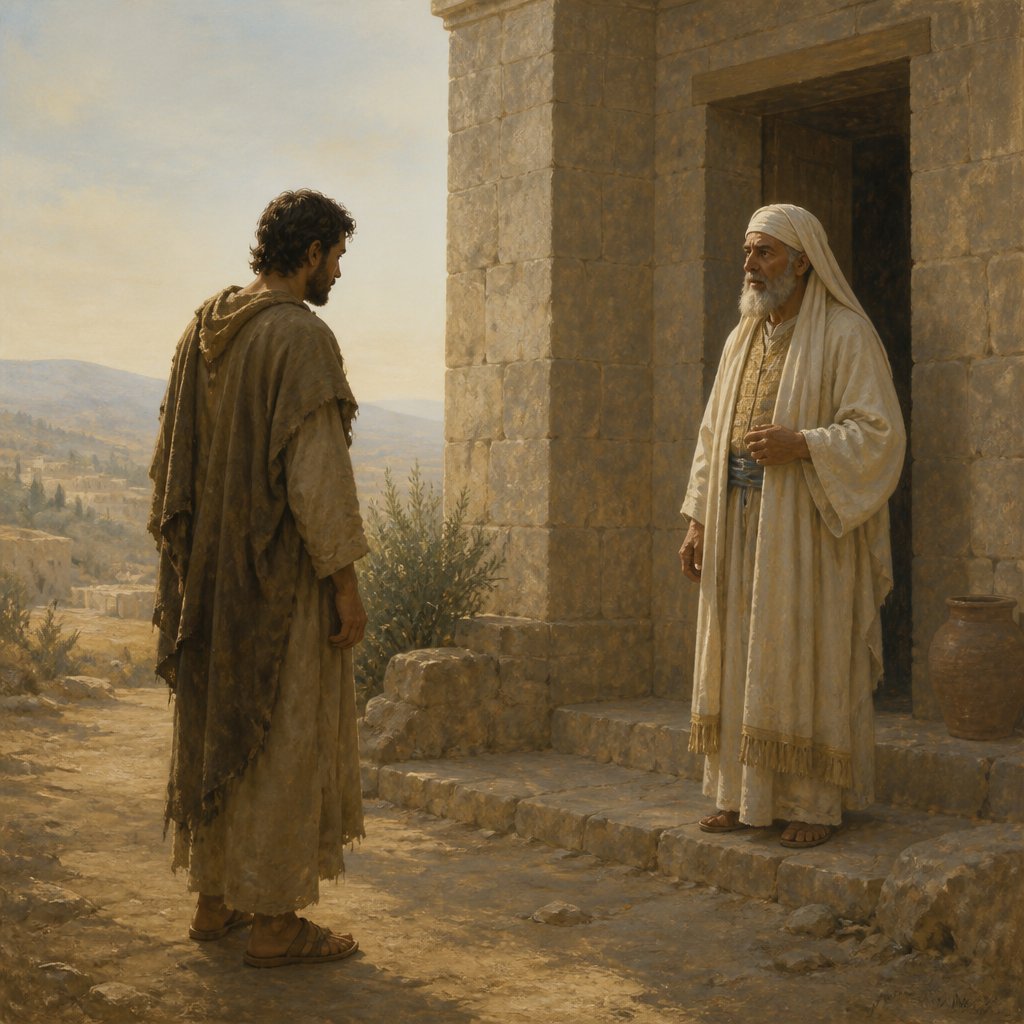
Mark my words; Doeg the Edomite was an evil man. Evil men do very evil things. He is immortalized forever in the pages of 1 Samuel as terribly wicked. Doeg is not a Hebrew, and he is called a chief shepherd overseeing other shepherds, and he was in the service of King Saul. 

Was he a captive? Was he a traitor? And what about this phrase, “detained before the Lord?” I got curious so I looked up the word, “detained.” The Hebrew word is pretty broad and I didn’t get any real insight. It’s used 46x and has several meanings, but the general sense is “restrained, halted, or stopped.” Why? 

(If you want, you can jump ahead to 1 Sam. 22:19 to understand Doeg’s heart.) 

In vv. 7-8 the spotlight is turned back on David and Ahimelech. David continues the charade. His deception lies continue as he presses his need to the high priest of Israel. David takes the holy loaves of bread, but he wants more. He really needs a sword. 

Apparently, the sword that Goliath carried had been kept in Nob in safe keeping. For the priests it was special, maybe even holy. No matter, it was a memento of a glorious victory, but everything is different now. 

“It is painful to the last degree to see one whose faith towered to such a lofty height in the encounter with Goliath, coming down from that noble elevation, to find him resorting for self-protection to the lies and artifices of an impostor.” William Blaikie 

Did you catch that? An imposter. David had become a deceiver, a liar. What do we do with that ugly indictment? I guess I have more questions than answers. Just maybe, in the heat of the moment lying became permissible. 

In Psalm 34 David wrote, Does anyone want to live a life that is long and prosperous?  Then keep your tongue from speaking evil and your lips from telling lies!” 

Wow, David. Are you sure about that? To be honest, I don’t want to malign with David. After all he was fleeing for his very life. Undoubtably there was a price on his head, and the bounty hunters would be out in force. David was scared out of his wits. 

You might say he was just being resourceful, and he didn’t want to implicate anyone else in his escape. Saul and his army were hunting him, and maybe David thought that the priests would be beyond Saul’s reach. Maybe they would have. 

Except for Doeg, the Edomite. 

Jonathan’s Secret Message

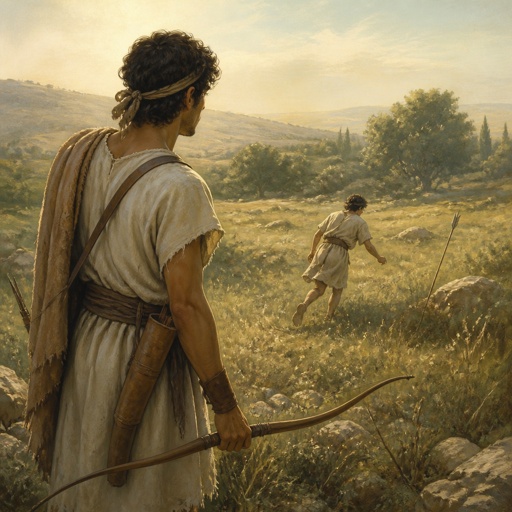
In verses 36-39 a young boy was chasing down arrows. The plan was one both David and Jonathan understood. If the arrows fell short, it meant David could return safely and securely to the court of Saul. But if the arrows went long, David had better run. 

1 Samuel 20:39-42, ESV

As I read these last few chapters, I’m amazed by David’s desire for reconciliation with the king. He desperately wants peace; David wants restoration, but the “ball” is in Saul’s court now. Now, I guess that I wouldn’t be as patient as David. But that only emphasizes the wonderful character of David. 

I also sense that David wanted to avoid the wilderness. He never wanted to go there, maybe the wilderness was a place of “death.” Maybe not a physical one, but a death to everything David knew. It would be a hard place: thirsting, scavenging, and hiding. A difficult place to survive. 

There is one last time that David and Jonathan will meet. I think it was something bittersweet, and each reassured their covenant to each other. There must’ve been much pain. Neither wanted this, of all things to happen. Sometimes we’ll be put in a similar situation. It’s always difficult. 

Jonathan, knowing that David has been anointed the next king of Israel, submits his heart to what the Lord God has decided though the prophet Samuel. He accepts this and refuses to take the route of Saul, rather Jonathan appeals to David as the future king. 

The request is a bit bold maybe, but Jonathan asks that David would honor this, “between my offspring and your offspring, forever.’” Jonathan is asking David to refuse revenge and not try to get even with the house of Saul. Now David could have made an end to Saul’s progeny; that could mean stability for him, and for Israel. 

It’s then that must say goodbye, each goes on their very separate paths. This is the very last time they were together, but I doubt they would never forget their covenant. 

True Colors

Saul wants to kill David

Jonathan now knows; his father’s true colors were now obvious, which almost always happens over time. Saul hates David and now begins an even more effort to murder him. His hatred now consumes him. The king is no longer rational. He wants to kill him. 

But Jonathan is committed to warning David. He loves his friend; and so, he sticks with a prearranged signal. He will risk everything. David must be warned. 

1 Samuel 20:36-38, ESV 

Those arrows were genius—a plan that was wonderful and kept Jonathan safe. And David would now know his next step. I must admit I see no reference to prayer or seeking God, that troubles me. (But I must assume the singer of Psalm 23 understood God’s protection and care.) 

1 Samuel 20:41-42 

David saw the arrows and heard Jonathan speak. I suspect his heart sank. He wanted reconciliation and he didn’t want to leave in this way. And he didn’t want to go out in the wilderness. He was now a fugitive on the run. 

David loved Jonathan and it showed it. There was nothing cold or professional. He expressed a love that went beyond “bad news.” It wasn’t contingent on terrible news, for it was real, authentic. He had made a covenant. 

David will now spend the next 10-15 years on the run from Saul. 

He will try to live in the wilderness. But David would be protected by the Lord, and although he didn’t realize it, he was on a timetable set by God Himself. The clock was running but David was learning many things about being a king. His education would be long and hard. 

“Experience: that most brutal of teachers. But you learn, my God, do you learn.” 

 C.S. Lewis 

I believe David still had his harp, and I believe he would still worship the Lord God. He would compose even more psalms. And much of the wilderness would be woven into what he would sing. Worship was at his very core. 

And worship is why we exist.

Influenced but Without Surrender

In an odd scene in the life of King Saul is recorded in 1 Samuel 19:18–24, where Saul, enraged, sends soldiers to capture David. Three groups are overpowered by the Holy Spirit, and each group begins prophesying instead of arresting David. Finally, a frustrated Saul himself goes to Ramah, and there he too is overcome by the Spirit: 

1 Samuel 19:18-24 

“Influence Without Surrender” is one of the better ways to explain this strange passage. Even after several readings, this seems to be the best interpretation. Saul (and three groups of soldiers) come under “the influence” of the Holy Spirit and are prevented from capturing David. 

God proactively intervenes in the life of His anointed one. 

David must have been in shock. God defends him in an astonishing way, but in a manner that amazed the onlookers. And David was learning what God was really like. When the Lord goes to battle, anything can happen. In His powerful sovereignty, God decides the weapons He will use. In Saul’s case, the prophetic works perfectly. 

Troop after troop is floored by the presence of a mighty God. Finally, Saul decides to intervene. Why isn’t David in custody? Saul intends to find out; when he steps into the prophet’s presence. When this happens, Saul falls under the very presence of God and encounters the Lord. 

And really, we must understand that Saul comes under the influence of God but refuses to surrender. Isn’t this the epitome of his life? He may understand, but Saul refuses to surrender and to yield and submit to the Lord God. 

That’s what God does to His rebellious and disobedient children. 

For rebellion is as the sin of witchcraft, and stubbornness is as iniquity and idolatry. Because thou hast rejected the word of the Lord, He hath also rejected thee from being king.

1 Samuel 15:23

Saul does this every time.

Climbing Out the Window

Engraving by Gustave Doré (1886)

1 Samuel 19:11-17 

Let’s consider the resourcefulness of Michal: 

Much of this passage deals with Michel, David’s first wife. She is clever, showing ingenuity in helping David escape. An explanation– When Saul realized that the Lord was with David and how much his daughter Michal loved him, 29 Saul became even more afraid of him, and he remained David’s enemy for the rest of his life. (18:28-29.) 

Her actions enabled David to escape. First, she warned him. Second, she gave him directions to leave their bed chamber. Third, put a facsimile of David in their bed to buy him more time to escape. They both knew that Saul’s troops were coming. 

Notice Saul’s distorted thinking; he considered her actions as a “betrayal.” He knew that David escaped due to her actions to gain David some time, 

Saul interrogated her himself; he strongly asserted that she helped David escape. She lied to protect herself–” “He threatened to kill me if I didn’t help him.” (v. 17.) Now this wasn’t true, but her own life was at stake. Whether or not the lie was necessary, it created enough latitude for her to escape any punishment. 

Her crafty wisdom would give David a chance to escape. 

One thing struck me reading the text. These troops were most likely man who had served under the direction of David against the Philistines. There is something false about them, a betrayal of what they knew as false orders to apprehend and to kill David. 

David would face these men again. Saul’s hatred and his attempted murder of David had just begun.  

Jonathan Understands

“And Saul spoke to Jonathan his son and to all his servants, that they should kill David. But Jonathan, Saul’s son, delighted much in David. And Jonathan told David, “Saul my father seeks to kill you. Therefore be on your guard in the morning. Stay in a secret place and hide yourself. And I will go out and stand beside my father in the field where you are, and I will speak to my father about you. And if I learn anything I will tell you.”  

4 “And Jonathan spoke well of David to Saul his father and said to him, “Let not the king sin against his servant David, because he has not sinned against you, and because his deeds have brought good to you. For he took his life in his hand and he struck down the Philistine, and the Lord worked a great salvation for all Israel. You saw it, and rejoiced. Why then will you sin against innocent blood by killing David without cause?” And Saul listened to the voice of Jonathan. Saul swore, “As the Lord lives, he shall not be put to death.”  

7 “And Jonathan called David, and Jonathan reported to him all these things. And Jonathan brought David to Saul, and he was in his presence as before.” 

1 Samuel 19:1-7 

What a strange sequence of events, but stranger things have happened and will happen to David (the future king of Israel). 

Saul finally takes his rage out into the open. He wants David to be executed, but he never offers any justification for his anger or decision. All he wants is David’s head. No explanation is given. David is regarded as a traitor, but to whom? 

Saul requires his court to take action. The king wants David dead. This proclamation has never happened before—the king of Israel demanding the death of another Israelite. This is the deep power of wickedness coming from a twisted heart. This can only come from something quite satanic. 

Jonathan, at this critical point, understands the strong power of covenant. He has vowed to defend David, no matter what the cost is. He will be true forever. So Jonathan determines to defend his “brother.” 

Jonathan has now become a spy. He listens closely and then passes to David about what has heard. He will defend him no matter the cost. Jonathan understands that the very life of David is in his hands. 

Jonathan reminds king Saul of the heroics of David on behalf of the nation of Israel. He speaks truth into untruth. Saul listens and is persuaded that his decrees are wrong. He backs off and vows to treat David favorably. 

Saul swears that David should not be touched (executed). That will be temporary as we can see. It seems that Saul’s wrath is simmering below the surface. His repentance is only for show, at least for this moment. Oh, the depth of an angry unforgiveness. 

Because of Jonathan’s intercession, David is forgiven temporarily, and he is restored to his place in court. Perhaps David’s past triumphs are the key to his present survival, at least for the moment.  

Saul Hates David

1 Samuel 18:28-30 

David was fighting two battles at once. He had to face King Saul’s hostility, and the ongoing war with the Philistine’s army. I suppose that it was a tremendous drain. After the battle he came home and found nothing but jealousy and anger. 

Saul was very afraid of David. 

Fear like this turned into deep seated malevolence and hatred. Despite his tremendous success he, upon returning home, found zero recognition. To many he was a hero, but to Saul he was despised and detested. And again, Saul was deeply afraid of David. 

Fear accomplishes nothing. Fear only destroys. 

Saul was in a spiritual downward spiral. It was just a matter of time before the end. King Saul had become evil. God’s Spirit had left him, and he was nothing more than a shell, vacant and empty of anything good. Perhaps David was grieved to see the king turn into something unrecognizable and dark. 

David had been anointed as the next king. 

The prophet’s word had been spoken. There would be resistance and hostility which seemed to contradict this prophecy. David would soon discover the enemies battle against what God had declared. (But what choice did he have?) 

God’s declaration of David’s anointing didn’t matter to Saul. He would continue the path he had chosen. David would continue to find success against the Philistines.

David Guzik 

100 Foreskins

24 When Saul’s men reported this back to the king, 25 he told them, “Tell David that all I want for the bride price is 100 Philistine foreskins! Vengeance on my enemies is all I really want.” But what Saul had in mind was that David would be killed in the fight. 

26 David was delighted to accept the offer. Before the time limit expired, 27 he and his men went out and killed 200 Philistines. Then David fulfilled the king’s requirement by presenting all their foreskins to him. So Saul gave his daughter Michal to David to be his wife. 

28 When Saul realized that the Lord was with David and how much his daughter Michal loved him, 29 Saul became even more afraid of him, and he remained David’s enemy for the rest of his life. 30 Every time the commanders of the Philistines attacked, David was more successful against them than all the rest of Saul’s officers. So David’s name became very famous. 

1 Samuel 18:24-30, NLT 

A snare had been set. King Saul wanted David dead. A trap would destroy him; Saul had the bait, and he also knew that nothing could be traced back to him. David had become very popular, and so Saul had to be very careful. 

Saul had a plan, and yet it seemed it was a good one. 

David was called upon to do what seemed impossible. Saul declared that David was to bring him back 100 “foreskins” taken from the dead Philistines. Now the Philistines had been a terrible problem for the people of Israel. They had been attacking and destroying without any restraint. 

Saul surmised that whether to win or lose, that the David problem would be resolved. If anything, David would be tarnished in the minds of the Philistines. Perhaps a bounty would be placed on David’s head. He would become a “target” and be especially hated. Perhaps this is true? 

But David would ultimately prevail. 

David exceeded and even doubled Saul’s wishes. Instead of just meeting, he doubled what Saul had required. Returning from the battle, he carried 200 of the foreskins back to the king. He returned with not just the minimum but surpassed it. 

Ah yes, the matter of the foreskins. First, we must understand how the Philistines had attacked and harmed Israel. They continued to advance and Israel hadn’t really responded to their continual harassment. Saul understood that many had died and he had no answer to their constant attacks. 

Second, David was a man of his times. Things were brutal and the very survival of Israel demanded a response. Yes, David needed to respond with force. The Philistines needed to know that Israel could return fire with fire. David did this. 

Third, these were dead men. David collected these foreskins from the dead his men had already killed. He didn’t seize the enemy and forced them to endure “surrender” their penises at “gunpoint.” David collected these foreskins from the Philistines that were already dead. 

Now granted this wasn’t perfect or New Testament theology, and yet it was the need of the moment.

The Shield of Meekness

1 Samuel 18:20-24 

There are a couple of layers here. In this passage we read 1) Saul’s thinking. 2) Saul’s men being faithful, 3) David’s response about it all. I suggest that we should gather up all three to understand what exactly is happening. 

In #1 we see something a bit sinister. Saul’s heart is full of evil. He wants David dead. When he finds that Michel really loves David, he manipulates that into his purposes. Saul doesn’t rejoice, rather he hates it. He devises a way to destroy David. 

In #2 we see that the king’s trusted men are those who smooth it all out. They manipulate it all to declare Saul’s “wonderful” offer of advancement. They are faithful, but not to the truth, but to Saul. (Every king, president or prime minister needs these sorts to do what he wishes.) 

In #3 we read about the thinking of David. He seems unaware of the evil that he has stepped into. We hear of his humility about it all. He recognizes that he’s unworthy to become a son-in-law. He brings up the subject of a dowery, the payment he must give to earn a marriage. 

It’s here that King Saul’s efforts seem to advance.  

Again, it’s how Saul works. He is still thinking that he’s in control (but he really isn’t). Saul doesn’t realize it, but he’s fighting against the purposes of God. It all seems simple to us now, but at that moment it’s not so easy. 

Andrew Murray 

Overcoming With an Opposite Spirit

1 Samuel 18:17-19 

Saul’s deceit is now effective. His heart wants to manipulate David; he wants to destroy him. As I read this portion, I’m struck by Saul’s evil. He wants David dead but is unwilling to do this sin on his own. He wants the ungodly Philistines to do this dirty deed. 

He falsely believes that David’s success is based on his military prowess. He thinks the skill of David militarily acumen is secular and superb. But it isn’t. David’s ability is grace. A gift of God to men. It really can’t be explained otherwise. 

Saul was a man bereft of the Spirit of God. 

I don’t think otherwise. Saul discovers his “kryptonite.” It is his denial of the belief of God’s presence on a simple man. Maybe he knows, but he also understands that something has changed; Saul has lost the anointing of the Lord. 

Saul has lost his way. And now he resorts to the human way of thinking. 

David is on a completely wavelength. In verse 18 he shows the humility and meekness of a heart that is saturated with God’s residence. I believe that this is called “overcoming with an opposite spirit.” I don’t think you can see this any other way. 

God is using David to communicate to us His heart. David’s humility is something built inside; He responds in an innocence that is seldom seen. He was sincere; what you see is what you get. 

David responds with a heartfelt love for Saul. David is totally sincere, and he responds reveals God’s heart toward Saul. (If only King Saul would listen to God. But that wasn’t going to happen.) 

The marriage between David and Merab was just pretense. Saul stepped in and blocked it; he would never allow David’s ascendance into the royal line.  

Something significant, I think. David still has his harp. He worships himself through this morass. That worship sustains him. When David plays, it’s a level of protection from his enemies. 

A word about “overcoming with an opposite spirit.” 

Faith does some amazing things in a simple believer’s heart. We must (incessantly) respond to evil in the way of David. He shows us how. 

Much could be said about how we interpret this passage, and yet I keep focusing upon David’s humility here. But the work is His. And we must see this insight of a man who is giving himself to the ways of God, even in the tumult of the moment, David rests in the Lord.

This will test the heart of David.

Leave the Spear Behind

And Saul hurled the spear, for he thought, “I will pin David to the wall.” But David evaded him twice.

1 Samuel 18:11, ESV

And Saul sought to pin David to the wall with the spear, but he eluded Saul so that he struck the spear into the wall. And David fled and escaped that night.

Saul attacked David twice.

But David spiritually understood God’s heart. He understood the spiritual principle of “turning the other cheek” and “loving your enemies.” He overcame with love and kindness. And lots of grace.

“Do not be overcome by evil, but overcome evil with good

Romans 12:21, ESV

The Greek word for “overcome” is νικάω which can be translated as “to conquer or to come forth victorious.” It is also used when someone is arraigned before a court of law but wins the case.

You cannot attack another without destroying yourself.

“We win by tenderness. We conquer by forgiveness.”

Frederick W. Robertson

We must leave the spear in the wall. You must not throw it back.

Jealousy Consumes Saul

1 Samuel 18:8-9, ESV

I once learned the proper way to kill a diamond-back rattlesnake. Obviously, you must be careful, and Saul was not. The snake’s venom would destroy him; he had been bitten, and he would not survive. Jealousy over David’s victories would totally ruin him. Saul’s envy will poison his heart and soul. 

Please do not be consumed by this sin. A disciple must learn how to work through the issues of jealousy, envy, and evil. The Holy Spirit will see that we will see these things head on. God will not allow us to fully enter His kingdom if we hold on to jealousy and anger. 

Jealousy is like drinking something poisonous and hoping that the other person will die.

King Saul is Poisoned by His Sin

“Danger, Will Robinson, danger!”  

(B-9 Robot, “Lost in Space,” 1967) 

1 Samuel 18:6-8 

David was quite successful. His tactical prowess exceeded the other military leaders; he was a dream come true, and everyone knew it. But, there would be a downside to being victorious in battle. Gavid was about to find this out. Things would start to get crazy, and it wasn’t his fault. 

Out came those who could sing. 

Everyone knew it. David’s successes became the song of Israel. What he achieved was the stuff of legends. When he returned, he found those who received victory. They would sing, but those songs would create issues. Saul would become offended, and that would become dangerous. David would soon find this out. He understood, and yet, he really didn’t. King Saul would never really accept David’s accomplishments; Saul blocked out the wonderous battles of David. 

King Saul could never accept this. 

“The anger of the king is a deadly threat.”

Proverbs 16:14 

Saul’s anger would develop into jealousy, and that was dangerous. 

We’ll look at this closer.

“The Battle is the Lords”

David knew what would happen before it actually did. Most likely it had to do with a faith that understood God, he truly accepted that “the battle was/is the Lord’s. He accepted this.

Not only did David see this in Goliath, but notice this in the text, “I will give the dead bodies of the host of the Philistines this day to the birds of the air and to the wild beasts of the earth, that all the earth may know that there is a God in Israel.”

David understood that David would be killed by him, but the entire army would also die that day.

It would be a total victory over the entire Philistine army.

Also, let’s consider this phrase “the battle is the Lord’s. David says this and establishes something each believer must embrace today. We live in a war that Satan has instigated. Each of us must know exactly what we’re up against. A killer, and a destroyer of people!

Check this out:

“The thief comes only to steal and kill and destroy. I came that they may have life and have it abundantly.” John 10:10

(Notice Jesus’ ministry on us though in this “wonderful” verse.)

Let’s go back to David. It seems when he was good he was very good, but if we’re to be honest, when he was bad, he was very bad. (But forgiven.) Now I don’t understand what you think about all of this. But he did repent, and he was pardoned.

David Faces Goliath

David Kills Goliath

1 Samuel 17:48-51

He moved in to attack. David had no sword, no shield. It was just him, and this monster from Philistia. He entered this valley, and he had nothing. Well, he did have his sling.

There was no one else from the Israelite who would engage the giant. No one but David. All were frightened, and yet all watched David step up. Keep in mind that Goliath blasphemed God, and even that didn’t matter. It seemed to have no effect. This was an army of cowards.

David was a man of faith.

He stepped out with courage and confidence, actually running to meet Goliath. And Goliath ran out to attack him. From the story of David and Goliath, we can learn that the God we serve is capable of defeating any of the giants in our lives—fear, depression, financial issues, doubts of faith—if we know Him and His nature well enough to step out in faith. When we do not know what the future holds, we have to trust Him. 

David becomes a vote of faith even for us today When he slung that rock he became our example. And we definitely need that.

“My attitude was and still is like that of David, who was ashamed that the armies of Israel would tremble before Goliath. Without hesitation he stepped forward with complete confidence in the God who had proven Himself to be faithful (1 Sam 17). For David, the size of the giant was irrelevant.”

David Hunt