War Crime: Aftermath

1 Samuel 22:20-23 

The terrible slaughter of the town of Nob had been total—well, almost. One man escaped and ran to David.  His name is Abiathar. He brought the report to David of the complete massacre of everyone. Abiathar also identified Doeg the Edomite as the murderer. 

David has a soul searching, reflective response to this news.  

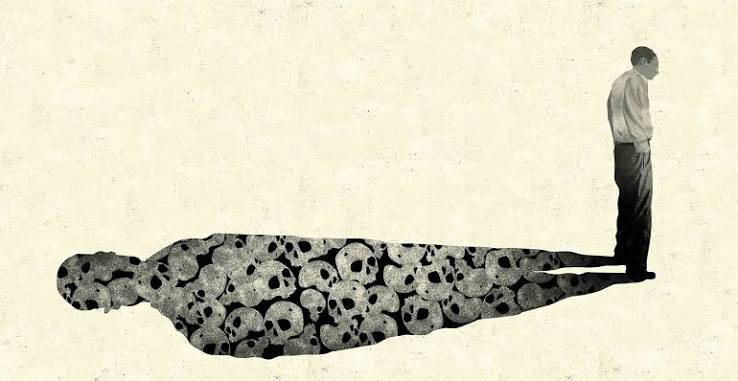
This intrigues me. “I knew…” and “I caused…” David now realized his actions had terrible consequences. He voices his complicity out loud. In his heart he sees his guilt (at least partially). This dark murder would change him. 

His sin was lying to the high priest.  

David deceived him. Doeg also saw David manipulating Ahimelech and Doeg remembered this. In a sense David in his awful duplicity created death for the priestly city of Nob. In his heart, he understood what he had done. 

We must realize how our evil has ramifications.  

It’s like throwing a rock in a still pool. Concentric waves happen as a result, and they cannot be stopped. Consequences to sin affect others and often we never realize it. But here we see David seeing it and responding like he did. 

David seems to have a tender heart to respond to what he has done. It becomes the impetus of Psalm 52 which was written during this time. Here we can read what he was thinking. Here’s the title and verses 1-3. 

Psalm 52:1-3

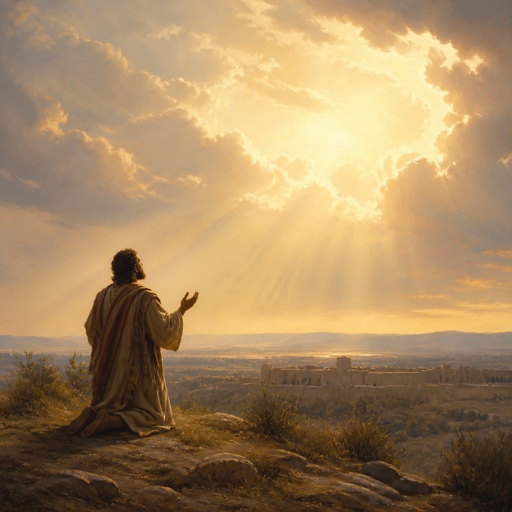
It’s quite apparent that David survives his guilt, and that is a powerful lesson for us. There are things that must be turned over to God. There is forgiveness for the evil we have done. We must give that to God. 

Psalm 103:12

War Crime

Why have you encouraged him to kill me, as he is trying to do this very day?” 

14 “But sir,” Ahimelech replied, “is anyone among all your servants as faithful as David, your son-in-law? Why he is the captain of your bodyguard and a highly honored member of your household! 15 This was certainly not the first time I had consulted God for him! May the king not accuse me and my family in this matter, for I knew nothing at all of any plot against you.” 

16 “You will surely die, Ahimelech, along with your entire family!” the king shouted. 17 And he ordered his bodyguards, “Kill these priests of the Lord, for they are allies and conspirators with David! They knew he was running away from me, but they didn’t tell me!” But Saul’s men refused to kill the Lord’s priests. 

18 Then the king said to Doeg, “You do it.” So, Doeg the Edomite turned on them and killed them that day, eighty-five priests in all, still wearing their priestly garments. 19 Then he went to Nob, the town of the priests, and killed the priests’ families—men and women, children and babies—and all the cattle, donkeys, sheep, and goats. 

20 Only Abiathar, one of the sons of Ahimelech, escaped and fled to David. 21 When he told David that Saul had killed the priests of the Lord, 22 David exclaimed, “I knew it! When I saw Doeg the Edomite there that day, I knew he was sure to tell Saul. Now I have caused the death of all your father’s family. 23 Stay here with me, and don’t be afraid. I will protect you with my own life, for the same person wants to kill us both.” 

1 Samuel 22:12-23, NLT 

The deeply paranoid king is desperate; he must capture David. Saul needs information and intelligence; at times like this he must rely on his network of spies. Most leaders depend on that. Especially bad ones. 

King Saul is trying hard to find David.

Saul’s consumed. He’s insane. When at last he gets a lead, he takes his army to the priestly city of Nob. Doeg the Edomite gives Saul the tip, he had seen David there, consulting with the Lord, and taking bread and a sword from Abimelech, the high priest. 

Simply based on Doeg’s singular witness, Saul will order the deaths of 85 priests and the entire town of Nob, a city populated with the Levitical priesthood and their families. When Saul orders the murder, his own men refused to carry it out. They simply refused, and so he must rely on the Edomite, Doeg. 

This passage is terrible and reveals all of Saul’s depraved brutality. 

One by one, systematically Doeg murders each priest. The bodies keep stacking up. It’s a massacre. Doeg now begins to slaughter their families. And then to all the livestock, until the entire town is one bloody graveyard. 

I admit I don’t understand exactly why? 

But there is one priest who escapes. Just one man and he flees to David and carries the horrific news of the wholesale slaughter of Nob. Saul and Doeg have completely decimated the city to punish them for aiding David. 

And David remembers seeing Doeg there. He also has a moment of truth as he understands his own guilt in this massacre. I suspect he now understands Saul’s cruelty, and David learns a lesson he will never ever forget. 

EnduringWord.com

“Until I know what God is going to do for me.”

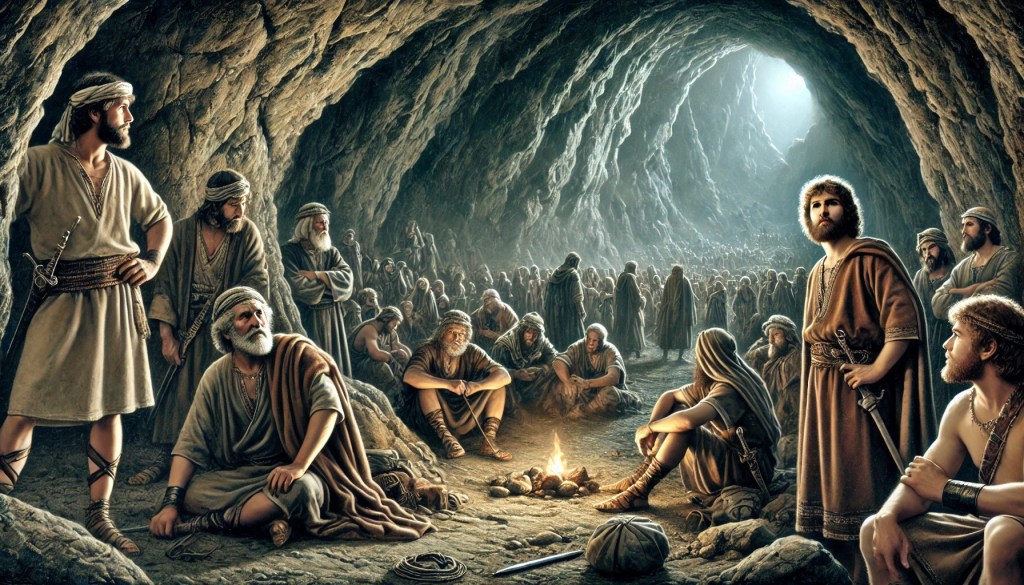
David and 400 (“the 3D men”) are together in the Cave of Abdullam waiting for what, I do not know. I suspect they didn’t know either. For any of us who are in a “holding .pattern,” David’s stay can be understood. But God hasn’t forsaken you, not a bit. Waiting on God is never easy. Every disciple goes through this. 

David takes up this time to care for his parents. You see they followed David out into the wilderness. I’m pretty sure that were prime candidates for blackmailing David. They could be easily taken as hostages by Saul, to manipulate David who is hiding. 

Now there is a reason that they went to Moab. David’s great-grandmother Ruth was a Moabite (Ruth 4:18-22, 1:4). That would mean that one of his parents could claim that Ruth was a grandma to one of them. It’s said that “blood is thicker than water.” That proverb has a powerful theological meaning. 

In his heart he’s taking it one step at a time, and he really doesn’t know what the next step is going to be. He’s walking by faith, not by sight. And you know that is how God works out His will. We don’t always understand, but we do obey. 

Gad the prophet steps up and speaks the word of God to David. He must return to Judah. That is probably not what David wanted to hear; after all, it’s moving toward danger. King Saul rules Judah, and David must be thinking that he would be moving into peril. 

King Saul hears of this and he’s waiting for David.

The safest place to be is in the center of God’s will. Perhaps it’s here that David pens this verse. David is learning that the Cave of Adullam is not a safe place, he must understand his real safety is in the Rock of God. 

Psalm 91:2


The Cave of Adullam

1 Samuel 22:1-2, NKJV. (Background: Psalm 57 and Psalms 142.) 

The cave of Abdullam is now a national park in Israel. It’s part of a system of caves, but this is the biggest and most well-known. Thousands visit it every year; it’s on the list that tourists want to visit. 

Our passage today tells us that immediately after the “insane” David skedaddled from Gath, he travelled to this cave. I suspect that Saul had spied everywhere, so the king had a general idea where David was. But the cave of Adullam was very close to the Philistine border. 

A state of war between Israel and Philistia existed, and king Saul could not risk any appearance of violating that without causing an incident. Perhaps Saul was somewhat content that David was isolated in a “hole in the ground,” and everyone would simply forget him. 

But the was not the case. 

First, it was family, then others came. I suspect David’s brothers may have realized that they now were on Saul’s “list.” 

The others had other reasons. Most knew of David’s prowess as a warband leader; some may have served with him. They may have known of his anointing by the prophet to be the next king. 

Now these I call the “three Ds.” The distressed, the debtors, the discontented, sought out David. Our text tells us there was 400 men (plus their families). If David thought, he was hidden and alone he was mistaken. 

Logistically, I’m not sure how that works out. Where did their support come from? And again, what was Saul thinking? 

I suspect that some of these would develop and become the “mighty men” of David, and they would become some of his generals that David would rely on when he became king. 

Verse 3 tell us that “he became captain over them.” They submitted to David and meshed themselves into whatever destiny may come.

Psalm 57:1, from a song written by David while in the cave of Adullum.

David Pretends Madness

‘Saul has struck down his thousands, 
    and David his ten thousands’?” 

1 Samuel 21:10-15, ESV 

David is now carrying Goliath’s sword, given to him by Abimelech the high priest. That sword was special, for David used it to cut off the head of the renown Philistine champion. I’m sure that David’s memories flooded back to him as he held it.

David was now carrying that sword into Goliath’s hometown. That was foolish and dangerous. He seems to move from the crisis of Saul to the crisis of seeking refuge with the Philistines. The risk was great, and yet David told himself that he had “no choice.” 

Is David still “a man after God’s own heart?” 

Sometimes as believers, we do very foolish things. God has a path for us, and instead of seeking Him we turn to our own understanding. When I think through this account, I come to the realization that I seldom look to the Lord for His wise direction. 

“When people do not accept divine guidance, they run wild. But whoever obeys the law is joyful.” Proverb 29:18 

On his arrival in Gath, David hears the murmuring of the crowd. Interestingly, they call David “the king of the land.” They recognized this before Saul did. This is the first time David has heard that they have known him. That song comes up, and it seems again (like always) it just creates even more problems.

David thought he could find anonymity or sympathy from the Philistines. 

Our passage tells us that David is now “much afraid.” I think he realizes then he has made a very stupid decision by going to Gath, (carrying Goliath’s sword for all to see). His reputation has proceeded with him, and yet David has another plan.

He feigns insanity. I suspect that this was just a split-second decision, something rash and impulsive. He knew that acting insane was the only way to escape. He attacked the doors, scratching them. He foamed at the mouth with his saliva dripping down his beard. 

One look at David acting crazy we see that king Achish dismissed David and his antics as beneath his deliberation. He sees David as a madman, and apparently the king has had his fill of madmen. Some have said that the very presence of an insane person was an evil omen. And to kill them was forbidden. 

The question I have is this. Was David walking in the Spirit or in the flesh? Was David outside of God’s will while he was in Gath?

The title of Psalm 34 reads: “A psalm of David, regarding the time he pretended to be insane in front of Abimelech, who sent him away.” 

The title of Psalm 56 reads: “A psalm of David, regarding the time the Philistines seized him in Gath.” 

Now these are beautiful psalms, and they describe David’s experience in the very heart of the Philistines’ stronghold. Things are getting strange, but David’s heart is still in God’s hand.

What happened here has given believers hope and guidance for centuries.

David Deceives the High Priest

1 Samuel 21:7-9, ESV 

Mark my words; Doeg the Edomite was an evil man. Evil men do very evil things. He is immortalized forever in the pages of 1 Samuel as terribly wicked. Doeg is not a Hebrew, and he is called a chief shepherd overseeing other shepherds, and he was in the service of King Saul. 

Was he a captive? Was he a traitor? And what about this phrase, “detained before the Lord?” I got curious so I looked up the word, “detained.” The Hebrew word is pretty broad and I didn’t get any real insight. It’s used 46x and has several meanings, but the general sense is “restrained, halted, or stopped.” Why? 

(If you want, you can jump ahead to 1 Sam. 22:19 to understand Doeg’s heart.) 

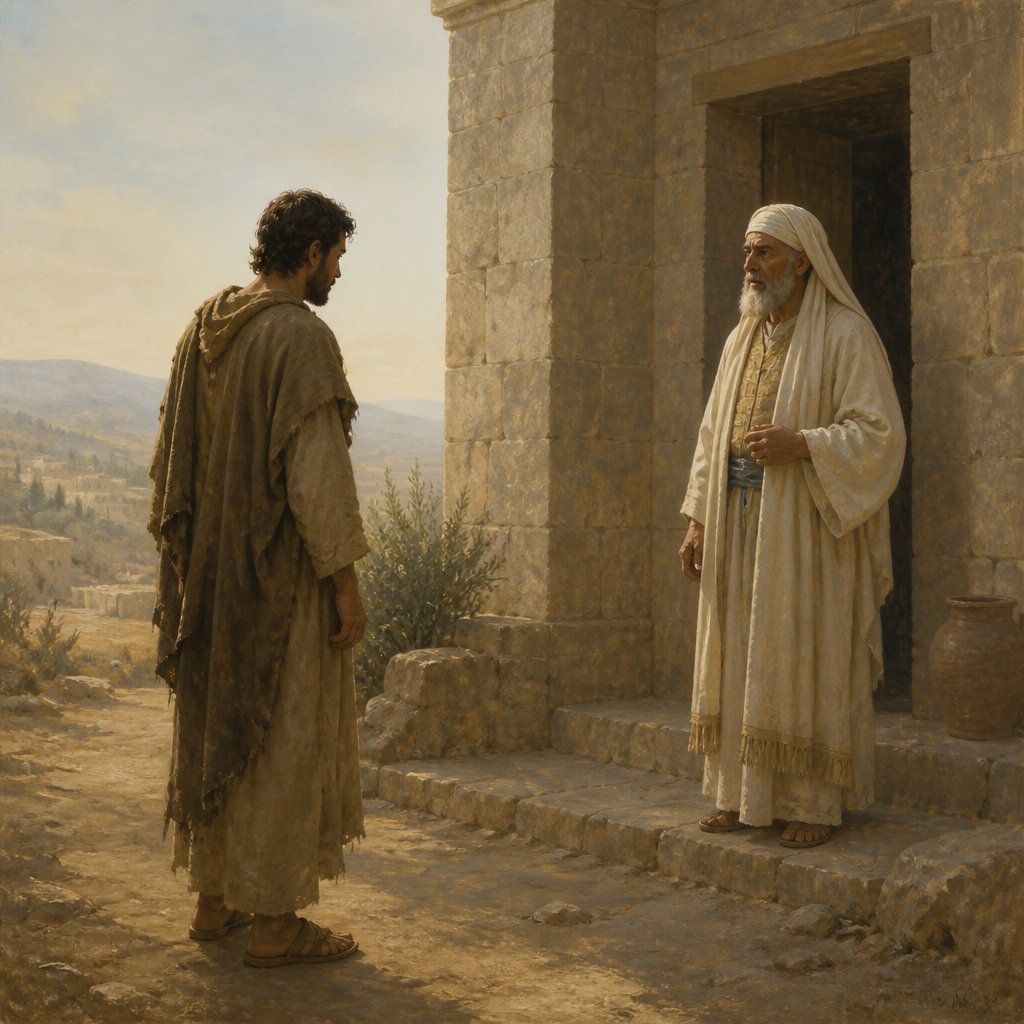
In vv. 7-8 the spotlight is turned back on David and Ahimelech. David continues the charade. His deception lies continue as he presses his need to the high priest of Israel. David takes the holy loaves of bread, but he wants more. He really needs a sword. 

Apparently, the sword that Goliath carried had been kept in Nob in safe keeping. For the priests it was special, maybe even holy. No matter, it was a memento of a glorious victory, but everything is different now. 

“It is painful to the last degree to see one whose faith towered to such a lofty height in the encounter with Goliath, coming down from that noble elevation, to find him resorting for self-protection to the lies and artifices of an impostor.” William Blaikie 

Did you catch that? An imposter. David had become a deceiver, a liar. What do we do with that ugly indictment? I guess I have more questions than answers. Just maybe, in the heat of the moment lying became permissible. 

In Psalm 34 David wrote, “Does anyone want to live a life that is long and prosperous?  Then keep your tongue from speaking evil and your lips from telling lies!” 

Wow, David. Are you sure about that? To be honest, I don’t want to malign with David. After all he was fleeing for his very life. Undoubtably there was a price on his head, and the bounty hunters would be out in force. David was scared out of his wits. 

You might say he was just being resourceful, and he didn’t want to implicate anyone else in his escape. Saul and his army were hunting him, and maybe David thought that the priests would be beyond Saul’s reach. Maybe they would have. 

Except for Doeg, the Edomite.