
The Encourager

1 Samuel 20:1-4, ESV 

David leaves Naioth behind, as he realizes that Saul (and his soldiers) had been temporarily “disabled.” He knew that the threat to assassinate him had for the time being had been stalled, and yet David didn’t stay for the theatrics. He simply knew it was time for an escape. 

And yet David seems mystified, and he reaches out to Jonathan with 3 questions that trouble him. It seems David is loyal, but he simply doesn’t understand the intensions of Saul. In all three questions David asks “what.” He is mystified. 

It takes the humility of Jonathan to attempt to ease David’s fear. 

Jonathan answers in an oblique way. He assures David that he can protect him with what he knows. Jonathan is aware of Saul’s treacherous plans and assures David of the strategies and plans that the enemy is concocting. He will do all that he can. 

It is here that we begin to understand that Saul is drawing near, and that David realizes that certain death has gotten very close. David understands how close he has come to being killed at the hand of Saul. “A step between me and death” is how David sees the plots of Saul. 

Again, Jonathan assures David of his commitment. Although he does not debate the claims of David, he simply assures him of his covenantal dedication. Jonathan encourages a discouraged man, and he speaks hope to the struggling David. 

This is what an encourager does. They bring comfort to the frustrated and weary. They stand in a remarkable place, and although they won’t deny the facts, they give strength to the weary. They declare all that God is to those who are overwhelmed and fearful. 

“He gives power to the weak and strength to the powerless.”  

Isa. 40:29, NLT 

This comfort usually comes through people—servants of God who do not debate but encourage. They have renounced their own agenda and now live for others. They embolden, spurring others to be faithful to their calling. 

Charles Spurgeon 

The Shield of Meekness

1 Samuel 18:20-24 

There are a couple of layers here. In this passage we read 1) Saul’s thinking. 2) Saul’s men being faithful, 3) David’s response about it all. I suggest that we should gather up all three to understand what exactly is happening. 

In #1 we see something a bit sinister. Saul’s heart is full of evil. He wants David dead. When he finds that Michel really loves David, he manipulates that into his purposes. Saul doesn’t rejoice, rather he hates it. He devises a way to destroy David. 

In #2 we see that the king’s trusted men are those who smooth it all out. They manipulate it all to declare Saul’s “wonderful” offer of advancement. They are faithful, but not to the truth, but to Saul. (Every king, president or prime minister needs these sorts to do what he wishes.) 

In #3 we read about the thinking of David. He seems unaware of the evil that he has stepped into. We hear of his humility about it all. He recognizes that he’s unworthy to become a son-in-law. He brings up the subject of a dowery, the payment he must give to earn a marriage. 

It’s here that King Saul’s efforts seem to advance.  

Again, it’s how Saul works. He is still thinking that he’s in control (but he really isn’t). Saul doesn’t realize it, but he’s fighting against the purposes of God. It all seems simple to us now, but at that moment it’s not so easy. 

Andrew Murray 

Overcoming With an Opposite Spirit

1 Samuel 18:17-19 

Saul’s deceit is now effective. His heart wants to manipulate David; he wants to destroy him. As I read this portion, I’m struck by Saul’s evil. He wants David dead but is unwilling to do this sin on his own. He wants the ungodly Philistines to do this dirty deed. 

He falsely believes that David’s success is based on his military prowess. He thinks the skill of David militarily acumen is secular and superb. But it isn’t. David’s ability is grace. A gift of God to men. It really can’t be explained otherwise. 

Saul was a man bereft of the Spirit of God. 

I don’t think otherwise. Saul discovers his “kryptonite.” It is his denial of the belief of God’s presence on a simple man. Maybe he knows, but he also understands that something has changed; Saul has lost the anointing of the Lord. 

Saul has lost his way. And now he resorts to the human way of thinking. 

David is on a completely wavelength. In verse 18 he shows the humility and meekness of a heart that is saturated with God’s residence. I believe that this is called “overcoming with an opposite spirit.” I don’t think you can see this any other way. 

God is using David to communicate to us His heart. David’s humility is something built inside; He responds in an innocence that is seldom seen. He was sincere; what you see is what you get. 

David responds with a heartfelt love for Saul. David is totally sincere, and he responds reveals God’s heart toward Saul. (If only King Saul would listen to God. But that wasn’t going to happen.) 

The marriage between David and Merab was just pretense. Saul stepped in and blocked it; he would never allow David’s ascendance into the royal line.  

Something significant, I think. David still has his harp. He worships himself through this morass. That worship sustains him. When David plays, it’s a level of protection from his enemies. 

A word about “overcoming with an opposite spirit.” 

Faith does some amazing things in a simple believer’s heart. We must (incessantly) respond to evil in the way of David. He shows us how. 

Much could be said about how we interpret this passage, and yet I keep focusing upon David’s humility here. But the work is His. And we must see this insight of a man who is giving himself to the ways of God, even in the tumult of the moment, David rests in the Lord.

This will test the heart of David.

A Grinding Humility

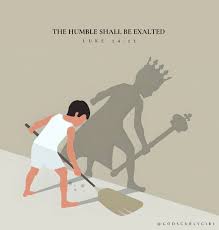
Luke 14:11

David was the eighth and youngest son of Jesse. They lived in Bethlehem and David served his father by tending his sheep. Like Moses, David learned the skills from life as a shepherd. He wasn’t valued by his family. He lived out in the field and simply did whatever he was told.

A diversion for young David was to sit and play a lyre. It calmed the sheep, and gave himself something to break the blind-numbing boredom of watching over a flock. He also learned the sling, punching rocks at targets both near and far. He got really good at both.

These things will determine David’s role as a king, and a shepherd of the nation of Israel.

But these are humble acts which seem small at best. And yet, given time, they will grow and will become the very basic foundations of a good king. Being a shepherd and protecting the flock is exactly what God wants. He seeks out those who have His heart.

Just perhaps this is what it really means to be a pastor, an elder, or a deacon. May we look to those who love the flock, and who can throw a stone or two.

John Stott